
Running a Sex Offender Check in Sussex County
The official starting point is the New Jersey Sex Offender Internet Registry. The New Jersey State Police manages the central system. The Sussex County Prosecutor takes part in risk tiering and public notice, while local police register residents in municipalities with their own departments. These roles overlap, but they are not interchangeable. The public portal is best for a name or place-based check. A local police report is the right route when the concern is a suspected failure to register or a materially false address.
Prepare the person's known name and the place tied to the search. Read the registry terms before relying on a result. A listed profile is a public notification record, not the underlying Sussex County court case or a fingerprint-based State Bureau of Identification history. The registry itself warns that details can be late or wrong. It also says fingerprints are the only conclusive way to confirm identity. That warning matters when names, ages, or physical traits are similar.
Sussex Registry Absence Has Limits
No match should be read as an all-clear. New Jersey's Internet registry contains the subset of records authorized for online disclosure. It does not claim to list every person ever convicted of a qualifying offense or every person known to law enforcement. Tier One cases are generally not published online, and Tier Two publication can depend on the statute, a court order, and applicable exclusions.
A Sussex County registry search can also miss the person the reader had in mind because of spelling, location, or identity uncertainty. Check the search terms, try the lawful place-based route offered by the live portal, and review its current notice. If the question is about a conviction or sentence, use the Judiciary case file instead. If it concerns a possible registration violation, report the facts to the police agency responsible for that address.
Note: A missing Internet result does not prove that no qualifying history or nonpublic registration record exists.
Searching the New Jersey Sex Offender Internet Registry
The state registry is free to consult for public safety. Its live interface blocked automated inspection during the Sussex County research, so exact button names, radius values, dropdown choices, and alert controls cannot be stated with confidence. The supported approach is to follow the live screen and use only the modes it currently displays. Typical official OffenderWatch systems provide a name search and a geographic or address search, but the current New Jersey controls remain the authority.
- Open the official NJSP registry and read its conditions of use and accuracy notice.
- Select the live name or geographic search mode that fits the Sussex County question.
- Enter only the known details and compare the result list carefully rather than matching on a name alone.
- Open the public profile, review its status and address details, and use local police for a suspected material error.
The table separates verified search concepts from controls that must be checked on the live service. This keeps a Sussex County check useful without guessing at fields the NJSP may revise.
| Search concept | Input type | Required | Use |
|---|---|---|---|
| Name search | Live registry form | Follow live form | Looks for a known person by the name details the portal requests |
| Geographic or address search | Live registry form or map | Follow live form | Checks the public entries associated with a place |
| Radius and filters | Not independently verified | Do not assume | Use only values shown by the current NJSP interface |
| Alert signup | Not verified | No | No Sussex County alert feature is claimed without live confirmation |
Cross-State Sussex Registry Searches
County lines do not always match a person's past or present ties. The U.S. Department of Justice National Sex Offender Public Website, known as NSOPW, adds a cross-state search layer. It is useful when a known location falls outside New Jersey or when the correct state is uncertain. NSOPW does not turn the state records into a single national case file. It searches information supplied by participating jurisdictions, each with its own disclosure rules and update practices.
The official NSOPW search interface is visible in the source image below. Its national scope makes it a supplement to the Sussex County registry route, not a replacement for the NJSP profile or local police follow-up.
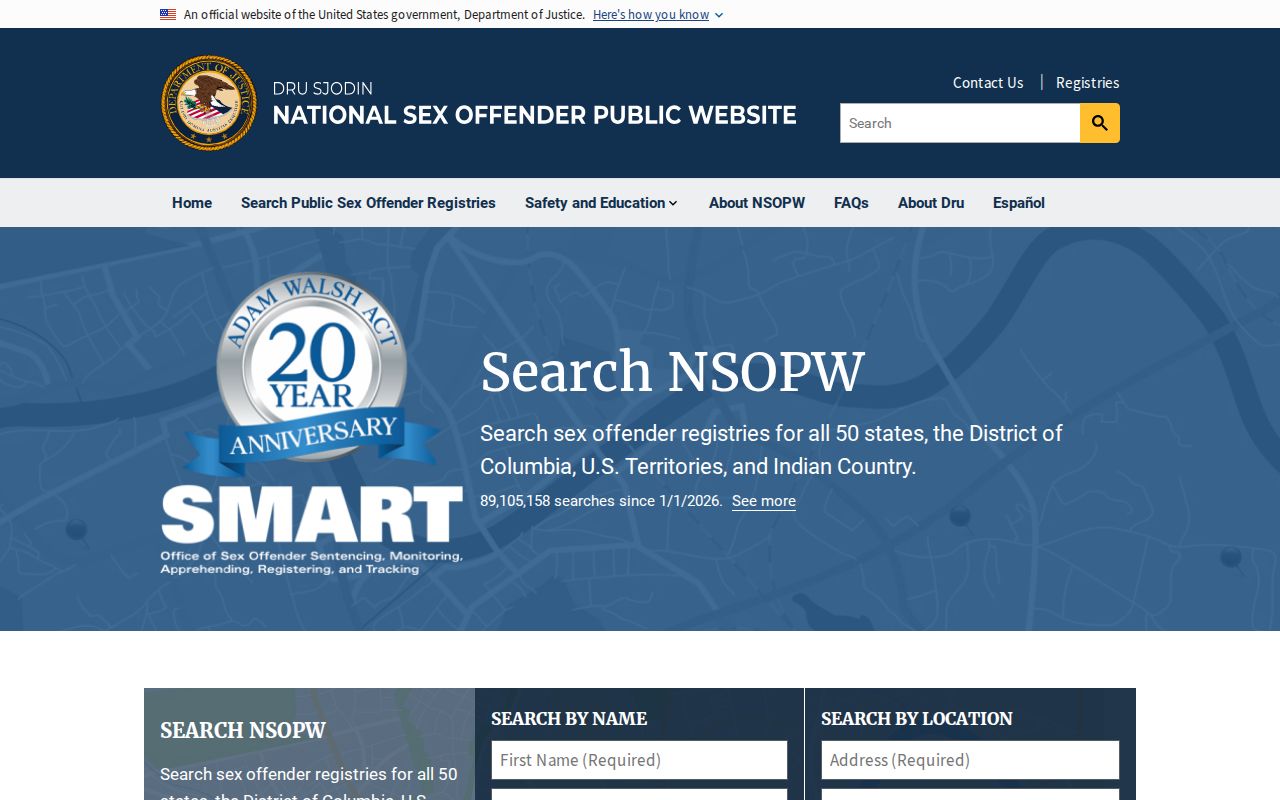
When a result points back to New Jersey, return to the NJSP registry for the state notice and use the appropriate Sussex County police department for a suspected address or compliance problem.
What a Registry Profile Shows
Attorney General notification guidelines support a set of facts meant for safety awareness. The actual public fields can depend on risk and the current interface. A profile may show more than a name and photo, but it still does not contain the police narrative, full court docket, or complete SBI record. Victim names are not part of the public profile inventory described in the guidelines.
| Name and aliases | The public identity labels released for notification and comparison. |
|---|---|
| Photo and description | A recent photograph and physical traits; the interface may also display scars, marks, or tattoos. |
| Residence and activity | A residence address and, when risk makes it pertinent, work, school, vehicle, or regularly frequented place information. |
| Qualifying offense | The offense supporting registration, not the full Sussex County criminal case file. |
| Tier and notice | The risk classification and public notification context allowed under New Jersey law. |
| Status and map data | The implementation may show status or map information; confirm the exact current fields in the live profile. |
Read all fields together. A photograph may age, an address may change, and a familiar name may belong to someone else. For any decision that turns on identity, the registry's own fingerprint warning should control.
Sussex County Registration Channels
Registration usually begins with the chief law enforcement officer where the registrant lives. In Vernon, Sparta, and Hopatcong, that means the municipal police department. NJSP handles the function in places without a local force. This local structure explains why a Sussex County address concern should go to the police agency for that municipality rather than to a general county records counter.
The Sussex County Prosecutor's Office handles county Megan's Law tiering and notification work. Its main office is at 19-21 High Street, Newton, NJ 07860, and the telephone number is 973-383-1570. The Prosecutor's role is distinct from the statewide portal run by NJSP and the front-line registration work performed by local departments.
For a suspected failure to register or a materially incorrect address, give the responsible police agency the facts that prompted the concern. Do not investigate at the residence and do not confront anyone. Call 911 only for an emergency. A data question or routine concern belongs on the agency's normal line.
Registration Requirements and Levels in New Jersey
New Jersey uses risk and notification tiers. They should not be confused with the federal SORNA shorthand of fixed 15-year, 25-year, and lifetime tiers. Registration under New Jersey law is generally continuing. Some registrants may apply to Superior Court for termination after the statutory period, but that relief is not automatic and exclusions can bar it.
| Risk tier | Notification scope | Duration and verification |
|---|---|---|
| Tier One | Law enforcement likely to encounter the registrant; generally not a public Internet tier | Registration generally continues; most registrants verify annually |
| Tier Two | Law enforcement plus schools or community groups likely to encounter; online publication depends on law, orders, and exclusions | Registration generally continues; most registrants verify annually |
| Tier Three | Law enforcement, relevant groups, and members of the public likely to encounter; broad notice | Registration generally continues; repetitive or compulsive registrants verify every 90 days |
All registrants also have prompt address-change duties. Under N.J.S.A. 2C:7-2(f), certain people may ask Superior Court to terminate registration after 15 years from conviction or release, whichever is later, if they remain offense-free and are no longer likely to threaten safety. Serious offenses and other statutory bars can defeat the request.
Sussex Tier Two Registry Visibility
Tier Two is often misunderstood. It describes moderate assessed risk and a scope of notice, but it does not guarantee that every Tier Two registrant appears on the public Internet registry. Statutory rules, court orders, and exclusions can affect publication. That is one reason a Sussex County name search cannot be treated as a complete census.
The distinction also keeps the registry's role clear. Risk tiering is not a new finding of guilt. The qualifying case came through the criminal process. Tiering governs who receives notice and how broadly it may be shared. Readers who need the charge history, disposition, or sentence should consult the appropriate court record rather than trying to infer the entire case from a registry profile.
Sussex Registry Data Context
Broad crime statistics answer a different question from an individual registry lookup. The NJSP Uniform Crime Reporting library provides official reports for studying reported crime patterns, while a Sussex County registry profile concerns public notification about one registrant. Neither source should be made to say what the other does.
The official report library appears in the source image below. It helps place public safety data in its proper statewide reporting setting without turning aggregate crime counts into assumptions about a person.
Use registry profiles for the limited safety notice they provide. Use NJSP reports for trend research, and use court or police records when the underlying incident or disposition is the actual subject.
Lawful Use and Community Notification
Registry information exists for public safety awareness and sensible planning. It may help a family understand a state notice or help a resident identify the correct police agency for a possible compliance concern. It is not permission to threaten, shame, follow, or punish a listed person, family member, workplace, or school. The public should report credible facts and let law enforcement assess them.
New Jersey's Internet registry authority and misuse limits appear in N.J.S.A. 2C:7-12 through 2C:7-19. Those rules limit public disclosure and make lawful use a core part of the search process. Sussex County residents should also remember that an old or mistaken detail can create real harm, so identity and current status must be checked through official channels.
Misuse is a crime: N.J.S.A. 2C:7-12 through 2C:7-19 prohibit using registry information to threaten, intimidate, or harass a registrant or associated person. Do not confront anyone.
Use the local police nonemergency route for a suspected address error or failure to register. An immediate threat belongs with 911. No verified statewide blanket distance rule from every school or park was found in the official Sussex research, so proposed restrictions should not be repeated as current law.