
Criminal Cases in the Sussex County Courts
The Superior Court of New Jersey, Law Division, Criminal Part hears indictable Sussex County criminal cases. New Jersey calls these offenses crimes of the first through fourth degree rather than felonies. A complaint may begin in municipal court, but the Sussex County Prosecutor screens an indictable accusation for presentation, downgrade, remand, or dismissal. Cases that proceed at the county level are kept by the Judiciary's Criminal Division, not the elected County Clerk.
Municipal courts maintain a separate layer. They hear disorderly-persons and petty-disorderly-persons offenses, traffic matters, and ordinance cases within their authority. The right clerk is the court where the matter was heard, including a shared municipal court. A Sussex County name search limited to Superior Court can therefore miss a live municipal complaint. The records owner depends on both the charge level and what the prosecutor did with it.
PROMIS/Gavel Searches for Sussex Cases
The Judiciary's PROMIS/Gavel Public Access interface is the main online index for public criminal case data. It supports defendant and county-oriented search modes. Select Sussex when a county filter is offered, but test a statewide name search if the filing location is uncertain. Names can be misspelled, entered with a middle initial, or shared by more than one person. A docket or indictment identifier is stronger evidence than a name alone.
The official Find a Case directory separates criminal, municipal, civil, and judgment tools. That split matters because PROMIS/Gavel is not the Municipal Court Case Search and is not a police-report archive. The public result is an index to a court matter. It may show case events and an outcome without making every motion, exhibit, order, or discovery item downloadable.
The public criminal-case search screen shows how Sussex County court searches are divided by name and county.
That screen is a starting point, not the full Sussex County criminal file or a conclusive identity match.
How to Search Case Records
Use a layered search so the online index, municipal court, and records room each do the job they actually perform. Save the exact spelling and every case identifier shown. Those details help staff locate a paper, archived, or certified Sussex County court record when the web view is incomplete.
- Open the Judiciary Find a Case page and choose Search Criminal Cases for an indictable Sussex County matter.
- Choose the defendant or county mode, then enter the legal surname and enough given-name detail to narrow the result.
- Select Sussex when the portal offers a county list. Compare docket, complaint, and indictment identifiers before treating a result as a match.
- Check the separate Municipal Court Case Search or contact the hearing court when the accusation remained local.
- Ask the Sussex Criminal Division Records Room for the public document, certified copy, judgment, or archived retrieval needed.
PROMIS/Gavel controls can change between sessions. Required status should be read from the live screen.
| Field label | Type | Required | Format or use |
|---|---|---|---|
| Search type | Radio or tab | Yes | Defendant or county modes presented by the portal |
| Last Name | Text | Search dependent | Use the legal surname and test known spelling forms |
| First Name | Text | Search dependent | Helps narrow a common Sussex County surname |
| Middle Initial/Name | Text | Optional or unspecified | Use when displayed and known |
| County | Dropdown | Mode dependent | Select Sussex for a county-limited result |
| Search / Clear | Buttons | No | Submit the query or reset the fields |
Sussex Court Records Room Copy Route
The Sussex County Criminal Division Records Room is at the Sussex County Judicial Center, 43-47 High Street, Newton, NJ 07860. Its telephone is 973-579-0933. Call before travel or before ordering a broad file. Give staff the full docket, indictment, or complaint number and say whether the need is an index confirmation, plain copy, certified copy, judgment of conviction, or the available public case file.
Older or resolved files may have moved to the Superior Court Records Center. The local records room can explain the current Judiciary court-record request process and likely retrieval step. Ask for current page and certification charges because the official sources reviewed did not publish a Sussex-specific amount. Do not send a county-government OPRA request for a Judiciary case file. New Jersey Court Rule 1:38, not OPRA, governs court-record access.
The Judiciary's Criminal Division Records Room directory identifies the official Sussex County court record contact.
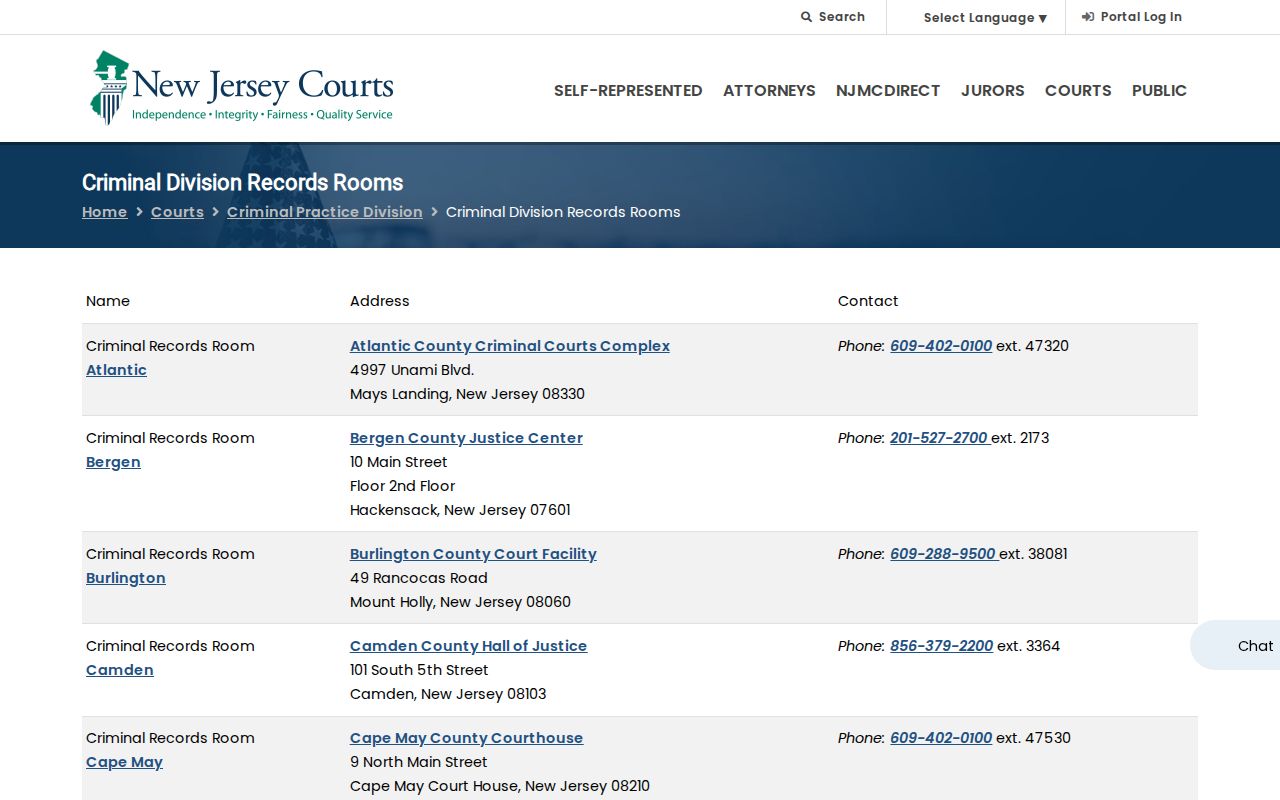
The directory helps route the request to the Judiciary office that holds the case rather than a county land-record office.
What the Case File Shows
A Sussex County court file is case-centered. It links the charging papers, docket activity, rulings, disposition, and sentence under court identifiers. It is not the same as the police narrative or Morris County booking file. Public fields vary with the case and the access level, but the record can show how each filed charge changed from complaint through judgment.
| Court and identifiers | Sussex County, division, docket or indictment number, and public complaint references |
|---|---|
| Defendant and status | Display name and the current public case status, which still require identity confirmation |
| Filed charges | Charge text, Title 2C citation, degree, amendments, merges, dismissals, or downgrades |
| Docket events | Public filing, hearing, indictment, disposition, and sentencing dates |
| Outcome and judgment | Disposition by charge and any public judgment of conviction |
| Sentence | Published custody, probation, financial, or other judgment components |
| Restricted content | Private identifiers, protected victim data, juvenile material, sealed filings, and expunged data are withheld or redacted |
Note: A public Sussex County docket may identify an event without providing the underlying motion, report, exhibit, or order online.
Sussex Criminal Charge Degrees
New Jersey's labels can trip up readers who expect felony and misdemeanor classes. Indictable crimes are graded from first through fourth degree and are handled in Sussex County Superior Court when prosecuted at that level. Disorderly-persons and petty-disorderly-persons offenses are petty offenses heard in municipal court. They are not called crimes for New Jersey's constitutional indictment and jury terminology.
The degree shown beside a charge is not the outcome. A filed count may be amended, merged into another count, downgraded to municipal court, dismissed, or resolved by plea or trial. Ordinary sentencing ranges run from ten to twenty years for a first-degree crime, five to ten years for second degree, three to five years for third degree, and up to eighteen months for fourth degree. Offense-specific laws and extended terms can alter those ranges, so read the judgment for the actual result.
- Indictment
- A grand jury's formal accusation that an indictable matter should proceed.
- Downgrade
- A charge transferred or resolved as a lower-level offense, often changing the court that owns the record.
- Disposition
- The outcome or status assigned to a charge or case.
- Nolle prosequi
- The prosecutor's formal decision not to continue a charge at that time.
Stages of a Criminal Case
A complaint begins the Judiciary record trail. The first appearance and a risk-based release or detention assessment follow. The Sussex County Prosecutor then screens indictable charges. A grand jury may return an indictment, after which arraignment, discovery, conferences, motions, plea talks, trial, judgment, sentencing, and appeal can each create new docket entries.
Case flow: Charges Filed › Arraignment › Pretrial › Plea or Trial › Disposition › Sentencing
New Jersey does not use a cash-bond-first model. Its Criminal Justice Reform system centers risk-based release terms and preventive detention in qualifying cases. A Sussex County criminal case may therefore display release or detention events without the simple bond amount found in records from other states. Read the court order instead of assuming a blank cash-bond field means the person was never held.
Why Sussex Arrest Charges Change
An arresting officer records the initial accusation based on the event known at that point. The Sussex County Prosecutor then reviews an indictable matter and may dismiss, downgrade, remand, amend, or supersede a complaint. Grand-jury action and plea negotiations can change the charge list again. The filed case is therefore the right source for what the State actually prosecuted, while the arrest report remains the source for the first police account.
This difference explains why an arrest record and a court docket may not match line for line. Compare the event date, arresting agency, complaint reference, and court identifier. Then read the disposition for each count. A dismissal does not erase the arrest by itself, and an expungement is a separate court process. For the initial agency record, the county's Sussex County arrest history channels explain where police, Sheriff, and custody files are kept.
Sussex Criminal Case Offices
Several justice offices sit close together in Newton, yet each has a different role. The Judiciary maintains Sussex County criminal case records at 43-47 High Street. The Sussex County Prosecutor's Office, at 19-21 High Street and 973-383-1570, screens and prosecutes indictable cases. Its work includes Major Crimes, Grand Jury, Domestic Violence, Juvenile, Sex Crimes, and Gangs, Guns and Narcotics units.
The New Jersey Office of the Public Defender's Sussex office is a separate state office at 20 East Clinton Street, Newton, with telephone 973-383-9445. It represents qualifying defendants; it does not maintain the court's public docket. Victim Witness Advocacy works through the Prosecutor's Office and can explain case status and assist with impact statements, crisis needs, accompaniment, and property return.
The official Sussex Public Defender page shows the distinct defense-office channel.
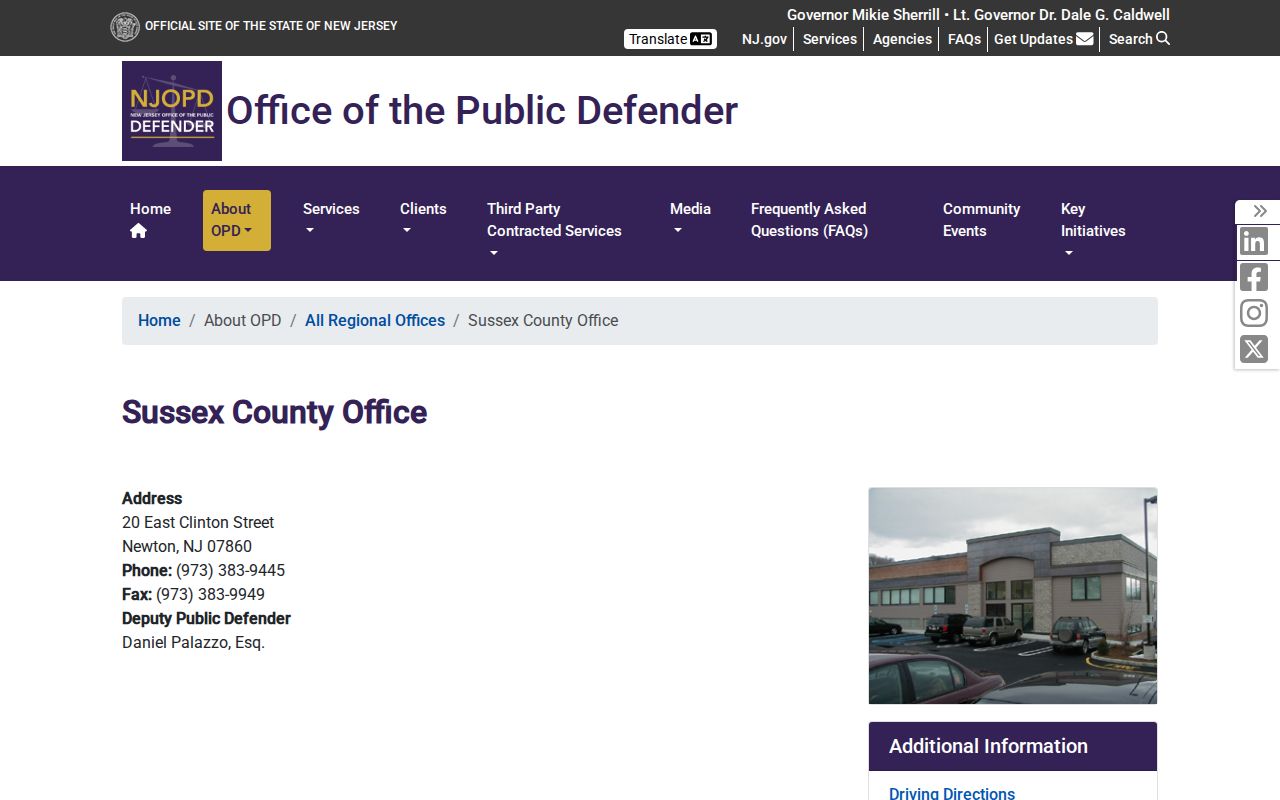
Its separate location helps show why a defense file, prosecutor file, and Judiciary case file are not interchangeable.
Access & Restrictions
New Jersey Court Rule 1:38 controls public access to court and administrative records. It also identifies confidential or excluded material. Sussex County files may omit or redact juvenile information, expunged material, grand-jury proceedings, protected victim or minor identifiers, Social Security numbers, financial-account data, medical details, sealed warrants, and security-sensitive content. Public discovery is not guaranteed merely because a docket entry exists.
A missing online result is not proof that no matter existed. It may be municipal, archived, entered under another spelling, restricted, expunged, or not yet reflected in the public view. Contact the court that owns the record and ask for the written access basis if a requested document is withheld. Judiciary denials follow court procedures, while police or prosecutor records may follow the Government Records Council OPRA route.